Showing posts with label drink bar. Show all posts

Saturday, 2 February 2013

Estonian micro revolution starting to get big.

Last weekend, I went down to Tartu to visit fellow beer shop owner, and beer geek Karmo. Karmo owns the excellent "õllepood Nr.1". The reason for my visit, was that there was a gathering of Tartu home brewers and Karmo wanted me to help judge their beers.


"Make sure you stay overnight" said Karmo, which I took to mean that there was going to be plenty of sampling going on.

Before I did the judging, I went next door to Möku, which is a nice little bar that has recently expanded its beer range. Lauri asked me if I'd like to give his staff a brief training session about some of their new beers, which of course I was very happy to do. Beer culture in Estonia has expanded so rapidly, that more and more beers are appearing on taps and in fridges each month - with the staff needing to know a bit about them. That in itself is refreshing - staff actually wanting to know about the beer they are serving. I think it goes to show that craft beer actually has a personality, with each having its own story to tell. Mainstream generic beers are boring - they all have the same life story - which is not really that exciting to tell the truth. So we had a good chat about beer, how it's made, why it tastes like it does bla bla bla, so much so that I over-ran and was late for my date by half an hour. I could have gone on for hours more.


So I arrived at Karmo's place, and there were already people there waiting for me. It was good to see that the usual photo fit of a home brewer wasn't present here. No socks, sandals and beards, but regular guys including two smartly dressed young educated gentlemen, a biker, a DJ and me. And Karmo - who has a beard and was wearing sandals with socks.


Now I have to admit - I'm not a fan of all home brewed beers. Some are very good, some are passable, but to be honest, most are pretty bloody awful. The people who make them, have to drink them. When you've spent a good few hours brewing and bottling them, you'll drink the sweat of your labours, no matter how it tastes. And what you'll also do - is give some to your friends and ask them to try  it. I get a lot of these - with requests of "honest feedback". Most of the time, I'm not entirely honest, but forthright enough to make sure that I don't get any second bottles sent to me.

Life is too short for bad beer. So I take a sip, and if I don't like it, then it gets poured down the sink.  Which is interesting in itself. I told an Estonian friend that I pour the beer away if I don't like it, and he looked at me shocked. "But it's free" he said. "How can you waste something that is free?" he asked. Whereas my viewpoint is that if I didn't pay for it, then I'm losing nothing by pouring it down the drain.

So when I was told that there was going to be over 20 different beers to try, I tried to work out how I was going to throw away the beer I didn't like - when I had the guy who made it sitting right in front of me.


As it turned out, it was pleasantly suprising. There were 28 different beers, which at times was a bit of a chore - because not all of them hit the mark. Some of them were not, how shall I put it...."to my taste". As all the narrative was in Estonian, I did my best to work out the ingredients, and in one beer I was sure there were bananas. A banana IPA I wrote on my tasting notes. When I submitted my feedback, I was given looks of astonishment and hilarity. "What sort of bananas do you have in England?" They all laughed. The beer didn't have any banana in it at all. Shame it tasted like it did. Drainpour!

But on the whole the beers were good. Some were excellent, with one Imperial Black IPA in my opinion, being good enough to sell to the public. It was the overall winner out of the bunch, with an IPA brewed by the same brewer coming in second place.


I left Tartu smiling, not only because I had tasted some nice new beer, but because I managed to sell six copies of my book to these home brewers too. That's the hotel sorted then ;)

So what's happening in Tallinn? What's not happening in Tallinn is more to the point. Talk of the town this month is that a new beer bar called Pudel has opened up in the up and coming area of Telliskivi. I'm lucky enough to be co-owner of it, and once again I'm glad that I decided to enter the beer industry when I left University, not sell washing machines like my old man wanted me to. The great thing about being involved in small scale bars, is that you get to pick and choose what brands you sell. If you're boring and want to make a sure fire profit, you go with the major brands, and basically sell your soul to them. If you are a bit more gung ho, and want to work hard at making a profit by being non mainstream, then you get to play around with some interesting beers, hoping that the fact you are being different will bring the punters in.


Pudel has its foot firmly in the non mainstream camp. It has the largest selection of beers in Tallinn (read, Estonia) with many of the brands making their debut. Punk IPA, Baltic Frontier, Thornbridge beers are all on tap, and there are world class ratebeer 100/100 beers on the shelves in the name of Mikkeller George Cognac Edition, Nelson Sauvignon and Trappist beers from Rochefort, Achel among others.


One of the other co-owners, also happens to be a brewer. Not a kitchen or garden shed brewer, but a full on "we're gonna make so much we're gonna keg it" brewer.  They call it Põhjala, which means Nordic Territory in English. They've been putting together a few brews, sampling it (I get bottles too, and I'm pleased to say that I don't have to drain pour them), re brewing it, sampling it over and over to ensure it's ready. Ready for what? Bottling and kegging with the intention of becoming the first Estonian micro/gypsy brewed beer available to buy in Estonia. They are so intent on becoming the best, that they learnt and borrowed resource from the best. Two of the brewers spent a week at Brewdog, and then Brewdogs brewer came over to Estonia to help them put together the beer.

Next Friday, the 8th of Feb in Pudel bar, the boys will be having a launch night for their new beer. It's called ÖÖ, which means Night in English. It's a Baltic Imperial Stout coming in at 9,5% abv, and like the name suggests, is a black as the night. Look out for the Facebook invitation - the brewer from Brewdog will be coming over too, so it's a great chance to try the beer and ask questions to the guys who created it. The very cool thing is that the beer is packaged in Key Kegs, which uses compressed air to dispense. No gas enters the beer, which means you get to taste it just as the brewer intended.

Just to whet your appetite for the 7th, I managed to blag myself a bottle, and reviewed it.

It's a 33cl bottle (50cl at 9,5% abv would be too much), with a striking design on the label. It depicts a black night, with twin, vanilla coloured moons, reminding me a bit of Tatooine's binary sunset in the Star Wars film.

The pour is nice and thick, and it is at this moment when you realise that the beer is as black as the label. It comes out like a sludgy engine oil, building a thick creamy foam which is coffee cream in colour. It's the sort of head Guinness drinkers like to boast they can rest a penny on top. Except this one didn't require any nitrogen or 181 seconds to pour.


The aroma is as you would expect (if you are experienced at this game) of a Baltic Stout. Loads of roasted scents such as burnt oak, coffee, caramel, liquorice, spice, raisins and alcohol. It's worth pointing out, that the head has diminished from its original state, but is still there, almost like a vicars collar on top of the beer.

The taste is similar to the aromas you pick up - but there is a little sweetness too, almost like black syrup or molasses. It's not overly bitter, and any bitterness that is picked up is mostly from the malts rather than the hops. It's nice and smoky, and has a good depth of flavour, starting with smoke, which turns into chocolate, which then turns to dark fruits. The alcohol is there, but it's very well hidden, making this an easy 9,5% beer to drink.

The finish is smooth, but also a little salty. I'm not sure if this salt is intended, as it gives a little medicinal saline finish to the beer - which doesn't really fit in with the rest of the flavour portfolio. I'm not talking sea water salt, but just a little hint towards the end. Normal people probably won't notice it at all. Such is my curse for being a geek.


The overall impression of the beer is that it's very good. It's up there in style with such luminaries as Mikkeller Black Hole, and Brewdog Alice Porter (which maybe even had the same brewer). Of course the real success story of this beer will be its loyal, Estonian fans. Estonian beer geeks have always been hunting for that really good beer made by one of their own, and now they have one. There is talk of more styles coming from them, including one called "Topelt Nelson", which is a dry hopped IPA using the Nelson Sauvin hop. Looking forward to that.

So, if you want to check out the new bar, and also check out the new beer, and also check out the brewers - then put a date in your diary/iphone/Samsung for the 8th of Feb. Check out Pudel Baar on Facebook for further updates. This stuff is great in bottle, but I suspect it will reach another level on tap.


Wednesday, 8 August 2012

The perfect pint.

I did a blog a couple of months ago about how to spot a dirty glass from a clean one when in a pub. Lots of people thought it was useful, and it occurred to me, that there isn't really a manual you can refer to when you are in a bar to see if everything is being done in the correct way.  One indication of course are the amount of people in the place. An empty pub, with bored staff is usually a good guideline that something is wrong. A closed pub, or one with "remont" in the window is another.


                                                   Remont.


When I was living in the UK, I used to work for a large brewery. This brewery invested in a training programme for all the pubs which served it's beer, making sure that it's beer was perfect from "grain to glass". Because after all, it's normally the beer that gets the bad reputation if you have had a bad one in a bar. I used to teach the people who served the beer what beer is, how it's made, what it tastes of, and most importantly - how to present it correctly.

The worse people to train were those who had been working in a bar for years. They think that they know it all and that the stupid customer would be happy with any beer that made them drunk. It was these people that I used to pick on, and ask them to pour the "perfect pint" in front of the group. Nine times out of ten they'd do it completely wrong. You can't teach an old dog new tricks. The best people to teach are actually those who haven't worked in a bar before, or are just learning the art. They haven't had the chance to pick up any bad habits yet.


                                           Not a classic English pint.


Maybe it's best not to know any habits at all. When I'm on the other side of the bar in a pub and waiting for my pint, it's sometimes a very painful experience. Estonia has the dubious honour, of being the first country I visited where I saw a teaspoon being used to help serve me my beer. I guess we've all seen it:

Walk up to the bar, and Svetlana (and they're all called Svetlana) is perched on a chair reading a magazine or trying to work out how to play Sudoku. "Hello" I beam in my best Hugh Grant accent, "I'd like a Krusovice please". "Ei Ole", she replies in her best pissed off accent. Umm ok. "How about a Budvar then thanks?" Shake of head by Svetlana with one eye on the Sudoku.  (It's worth pointing out that I wasn't just choosing random beers - these beers were all on the beer taps in front of me). "So what have you got then?" Saku she replied while starting to pour it. I guess I'll be having Saku then.  She then went through an incredible exercise of holding the glass upright and pouring the beer into it very fast. What happened then, was as the glass half filled with foam, she crossed over to the sink, got a teaspoon from it, and started to scoop all the foam out into the sink. She then returned to the pump, shot another load of foam and beer into the glass and repeated the trip to the sink and spoon again. This happened about five times, before she was finally happy (or bored - I don't think Svetlana's are ever happy) that there was enough beer in the glass for her to be able to charge me 40 kroon. Her only smile came when I gave her a 50 kroon note and she told me that she didn't have any change.


Svetlana doesn't even need to speak to customers anymore


This may have been seven years ago, but I bet if I walk into that bar today, the very same teaspoon will be sitting by the edge of the sink. The really sad thing is, that it's not just this bar. There's a Svetlana working in pubs all over town.

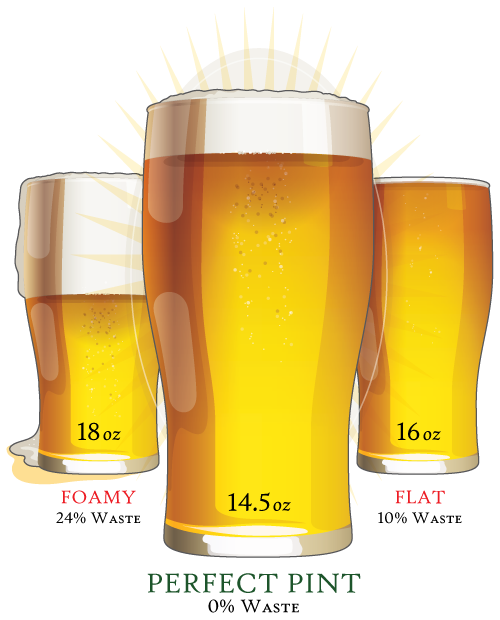
So how should the bartender pour the perfect pint? It's easy isn't it - pick up the glass, pull back the tap, fill it with beer and hand it to the customer. Job done. Where's my tip?  Not so fast Tom Cruise....

Here's a 10 step guide of what should happen when you ask for a beer:

1) You should get a smile and a hello. There should be a short amount of time for you to choose your beer, and then if you still haven't, the person behind the bar should ask if you need a help in deciding what you want. Please try and be a helpful customer and don't just say "a beer". You wouldn't walk into a bar/restaurant and order "a wine" would you? If you know what you want, proceed to Step 3.

2) Once you've specified what type of beer you'd like (light, dark, strong, sweet, local, import etc), then hopefully the bar tender should be able to help you out and offer you some suggestions. A great idea from the bartender would be to allow you some samples from their draught selection to help you make the right choice.

3) Once you've decided, then the bartender should select the correct, clean, dry, glass (see the previous blog about glassware) and begin the pour.

4) Holding the bottom half of the glass (Mantra: Top half customer, bottom half bartender. You don't want fingers that have been handling money, beer kegs and bar flies all over the part that you put your lips on do you?), at an angle of 45 degrees, the glass is placed UNDER the spout but not touching it. The reason for this is that beer dries quite quickly and can form a crust on the outside of the spout when it's not being used. If the spout is put into the beer, then this crust can end up in your pint. And what about the story of the man who liked to drink out of the same glass for each beer without changing it? This man had nice cold sores on his lips. The bar tender liked to put the spout into the beer when pouring. The next day - everyone in the bar also had cold sores.

5) Treating the tap gently, the bar tender pulls back in one motion. It's not a slot machine and you don't get any more beer out for pulling it back quickly. Pulling it back slowly is just as bad too. Think about when you have a hosepipe and you put your thumb over it when there is water coming out. This is exactly what happens when the tap is opened too slowly. So in a fluid motion, the tap is opened and the beer comes out. The best method is to have the glass in the right hand facing towards the body. The beer should be hitting the top half of the glass and building up a small amount of head by the time the liquid reaches the top edge. This is when it should be straight up and almost full. Leaving a couple of cm short of the rim is the trick here.

6) The bartender should then "cream" the beer. This is a process of pushing back on the tap, which lets the beer come through a very narrow space in the spout. The effect is that there is more foam than liquid coming through the hole, leaving a nice head of a centimetre on top of the beer. Of course, if the beer is a Guinness, then there will be the mandatory 119.5 seconds settling time (inside knowledge - any good bar tender should be able to pour a Guinness in one go. It's all marketing).

7) If any beer has dripped down the sides, the bar tender should use some clean kitchen paper and wipe the sides of the glass. A teaspoon or dirty towel are not recommended!

8) Once again, holding the bottom half of the glass with the right hand, the bar tender should place a drip mat on the counter with the left hand, and put the glass down on top of it. If the glass is branded or has a handle, a nice touch is to rotate the glass around so that handle/logo are facing the customer.

9) The bartender should then ask if there is anything else, and if not, work out how much you owe them and tell the customer the amount in a pleasant undemanding (but authoritative) manner.

10) When all money transactions are done, then the bartender will say thank you and will tell you to enjoy your beer.

               The perfect pint. Saves the pub money too. Win Win.

Easy isn't it?  Unfortunately, I know that nearly everyone who reads this will be thinking that this is a "perfect world" scenario, and will be thinking back to the last pint of beer they were served. The only way that beer service can be improved is by the customer knowing what should be done, and acting on it if it isn't. I find that if the bar tender or owner isn't interested, then a good way is to write a quick email to whichever local brewers beer they are selling. A Le Coq give out "beer stars" to places with good service, but they are equally quick to take it away (along with any discounts) if they aren't happy with the condition of the beer or service.

So next time you walk into a bar, and interrupt Svetlana from her Sudoku, explain to her that you'd like your beer poured in a single number of attempts without the use of a teaspoon, or she might be puzzling why she's lost her job.


Tuesday, 3 July 2012

The glass is always cleaner on the other side...

I went to a pub the other day, ordered a draught beer and it was served to me in a Weston's cider glass.  Now, there's two things wrong with this. The cider glass has something called an "activator" on the bottom of it which enhances the gas in the liquid (more on this later). Basically, it makes it more fizzy. Unfortunately, I'd ordered a pint of Abbot ale - which isn't meant to be fizzy. The second thing wrong, is that it just didn't look right. I like my beer to be served in it's own branded glass.

Its a bit like sticking a Citroen badge on VW. You know it's a VW, but it doesn't look right, and the car would perform so much better with its correct badge on the bonnet.


Glasses are designed to increase or enhance the performance of your drink. Take a wheat beer glass for example. Tall, 50cl, narrow at the bottom widening at the top. It looks nice, but this design has a purpose. The width allows for the aroma to be channelled towards the drinkers nose, and also accommodates the thick fluffy head that wheat beers have.


In the UK, until the end of the Victorian era, pub-goers mostly drank out of pewter tankards, which hid the bits of sediment that used to float around in their beer. Then two things happened: dark pubs began to be better lit, and modern filtration methods started to produce a clearer drink. As newly enlightened drinkers took more notice of the clarity of their pint, the modern beer glass was born.


The first mass-produced beer glass – the 10-sided, handled pint mug – arrived in the 1920s.


                         An advert showing a typical 10 sided handled glass
                                 

After the war, it was replaced by the dimpled beer mug which was cheaper to make, made of thick glass patterned with indentations, oddly resembling a hand grenade. This design change fitted in with changing drinking habits: dark beer had acquired an unfashionable image as an old working-class man's drink, and its substitute, amber bitter, looked lovely in the refracted light of a dimpled glass.


Then, in the 1960s, the dimpled mug went into a long, terminal decline because (or so the brewers told us) drinkers preferred a lighter, straighter glass. The invention of a new type of glass, with a bulge about an inch from the top, also solved the perennial problem of straight glasses – their tendency to chip near the rim when being washed together. The bulge prevented this from happening, and the glass was called a "Nonik" (no nick) glass.


The UK only really produces two types of beer: Lager and ale. These can be served in the same type of glass. It's when you go to continental Europe, that you'll see the different types of glasses really coming into play. Belgium is a great example.

I was in Bruges a couple of years ago and walked into a tiny little bar. This bar boasted over 200 different beers - I've no idea where they put them all. I ordered a beer, and is customary in Belgium, it arrived in it's correct branded glass. That got me thinking about their storage problem. Not only do they need space to store the beer, but also (if they have glasses for each beer) all the glassware too. So I did a test. The first beer I ordered was pretty mainstream - big brewers have money to spend on glasses. The second beer I ordered, I chose a much smaller brewery from the list, and sat back to see what glass it arrived in. Lo and behold, the glass matched the beer (it was a "De Graal Tripel in case you are wondering). The next beer I had, was a "Satan Red", which also arrived in it's own glass. I was suprised about this, not because I didn't think that the glass would be available, but suprised because THEY had any available. The problem with interesting glasses, is that they get stolen.


The iconic glass from Kwak is the worlds most stolen beer glass. The glass is distinctive because it stands upright in its own wooden holder. Legend has it, that this glass was used by a 19th century coach house, and that the wooden holder was designed to fit into the stirrups of the drinkers horse so that he could drink on the move. No such thing as drink driving laws back then.


The second most stolen glass in the world is also produced by the same brewery - the Tripel Karmeliet glass is a wonderful looking item, but once again it's designed with practical intentions. It's tapered at the top to allow a big creamy head. The only thing unpractical about it, is trying to sneek it into your wife's handbag when no one is looking (although seeing as it's a very popular glass to steal - it can't be that difficult).


I actually don't serve either of these beers at Drink Bar. While they are very good beers, whoever drinks them always wants the correct glass. As I've said, these are the two most stolen glasses in the world, so I think that if I did start stocking both the beer, and the glasses, in a short space of time I'd only have the beer. And there's nothing more disappointing than if you ordered a Kwak and it came in just a regular glass. The glasses are pretty hard to come by, and although I'd get some for free on my first order, after that I'd have to start paying for them. In Belgium, is a tradition that if you want a Kwak in a Kwak glass, you hand over your shoe as a deposit. I don't want to do that either - we're a small bar and the smell of ripe feet might put people off their drink!


Beer glasses aren't always beautiful. In many traditional pubs in the UK, you'll find an unusual item hanging up behind the bar - the "Yard of Ale". A yard of ale or yard glass is a very tall glass used for drinking around 2.5 imperial pints (1.4 l) of beer, depending upon the diameter. The glass is approximately 1 yard long, shaped with a bulb at the bottom, and a widening shaft which constitutes most of the height.[The glass most likely originated in 17th-century England where the glass was known also as a "Long Glass". It is associated by legend with stagecoach drivers, though was mainly used for drinking feats and special toasts.Drinking a yard glass full of beer is a traditional pub game. The fastest drinking of a yard of ale in the Guinness Book of Records is 5 seconds. You wouldn't want to be in a round with him.


There's also a boot you can drink out of.  Beer boots, or Bierstiefel, have over a century of history and culture behind them. It is commonly believed that a general promised his troops to drink beer from his boot if they were successful in battle. When the troops prevailed, the general had a glass maker fashion a boot from glass to fulfill his promise without tasting his own feet and to avoid spoiling the beer in his leather boot. Since then, soldiers have enjoyed toasting to their victories with a beer boot. At gatherings in Germany, Austria and Switzerland, beer boots are often passed among the guests for a festive drinking challenge. 


.
It is an old joke to hand the boot to a young novice drinker with the tip pointing away from his person, which will result in beer pouring over the drinker's face uncontrollably when air enters the tip Experienced drinkers always point the tip towards their body until the glass is sufficiently drained. It's the same with a yard - an experienced drinker will rotate the glass, to prevent the beer coming up from the bottom of the bubble and drenching them.


The general rule is that if it's a lager, then a regular nonic glass can be used. If it's a Pilsner, then it's best to use a Pilsner style glass which gradually taper outwards to let all those aromas out. Weiss beer is the same. If you're going to be drinking an ale, again a nonic or straight sided tulip glass can be used. No need for a stemmed glass - because the ale isn't going to be cold. The darker the beer, the more aroma you want to get from it. You might want to think about using a glass similar to what Chimay use. This allows for maximum air to get into the glass, and maximum aroma to come out. And if it's a very strong beer, you might want to think about using a smaller glass. Quite often, the stronger beers come in 33cl or even 25cl bottles. Something to sip and not gulp down is the order of the day here.


While lots of glassware dates back to tradition, there has been lots of new modern technology to help enhance your drinking experience. It is increasingly common to find pint glasses which contain markings on the base; very often these glasses are branded to one particular beer. The markings themselves are formed from small etchings which aid in allowing the gas within it to more readily release and thus preserve the head. Without the aid of these pits a regular pint glass will keep a head for only 3 or 4 minutes before appearing 'flat'.The markings come in a variety of styles ranging from a simple circular or square hatched pattern to more complicated branding messages.

                                                  An activated glass for Harp Lager.

I'm actually carrying out a consumer survey with Saku on this topic. The glass etching technology was new to them, and even though nearly every lager glass in the UK uses this system, Saku were still unsure of it's benefits.  I got some of their glasses mocked up with the Saku logo, and we're currently testing how drinkers think of the glasses compared to normal ones (go into Dubliner or Karja Kelder in Tallinn's old town and ask to take part - you'll get a free pint!). If the results are positive, then Saku will look to use activated glasses across their range. I must point out, that it's only for lager. There's no need for bubbles in ale. Here's a short video I made in my shed, proving how geeky you can get about glasses.


And keeping on the geeky theme - do you know how to spot a dirty glass in the bar? There's the obvious glass handed to you with lipstick smudges on it, but the less obvious can still mean the glass is dirty. In the video I explained about rising bubbles from the bottom of the glass showing the sign of a quality beer, but if you see bubbles on the side of the glass - then you should really hand that beer back and ask for a fresh one. The bubbles clinging to the inside of the glass, are actually trapped on particles of dirt. Yuk. You might sometimes see it on your glasses at home, because home dishwashers aren't as good as industrial glass cleaners. 

                                                 DISCLAIMER: That is not me.

Something else that ruins your beer inside the glass is milk. You should never wash a beer glass and a coffee cup in the same machine. The lactose in the milk makes the glass oily, and will kill head retention.  Same with fabric conditioner - let your glasses air dry, don't towel dry them if you want to keep the foam on your beer

A good way to identify a clean glass, is by "lacing". Lacing is the definition of the latticework of foam left on the glass after a drink has been taken. This is normally found when drinking ale, as ale is much more creamy and less carbonated than lager.  It's said you can tell how good the beer is , by counting the amount of sips (or gulps) to finish the beer.

                                    I finished this pint in 9 sips. I must have been tired.

So armed with this information - you're now going to send back any dirty glass you get served with aren't you? No, I didn't think so. Unfortunately, it's still a problem area in most bars. Many bar staff don't know the signs of a dirty glass, so will just shrug their shoulders and say that it's not their problem. Just as bar staff should be educated on which beer goes into which type of glass, they should also be taught how to correctly clean, dry and store glasses.  The main problem is, that many people still consider beer to be a cheap drink that gets you drunk. A dirty glass isn't going to prevent this from happening, so what does it matter if the glass is dirty, chipped or the wrong size? Quite a lot to my overall beer experience thank you very much. Cheers for the beer, but I won't be coming back to your bar again. 


Beer is a food. To serve it, you need a food licence and a health and safety certificate. I don't think many (although I am sure some do) serve food on dirty plates.

As Stella Artois say in their adverts "You wouldn't serve champagne in a teacup", and the more people who start to understand what they mean by this, the better. Demand more from your beer and it's glass!

I'll raise my glass to whoever starts the glass fightback!


Sunday, 8 April 2012

Hoppy Easter!

It's not just the Easter Bunny that hops.


Lots of talk in the brewing world at the moment seems to be centering on hop varieties. The focus (in craft beer) is moving away from the traditional English, Czech and German hops, and towards the "new world" plants from America, Australia and New Zealand.


What is a hop, what is it used for and what does it do?


Humulus lupulus is a species of Humulus in the Canabaceae family. In other words, it's the female climbing plant that is related to Cannabis plant. I wouldn't advise smoking it though, it's much better used in beer.They can be used in tea and soft drinks, and can also be used medicinally to send you to sleep, but of the approx 150,000 metric tonnes of hops that are produced worldwide each year, nearly all of it ends up as the vital ingredient in providing bitterness and aroma in beer.


Hops first started being cultivated in the Hallertau region of Germany. Their hops are still used to this day - even in our very own local beer Saku (sharp intakes of breath as people actually realise that Saku contains a) something so historic and b) hops). It wasn't til a couple of hundred years later that hops were used in brewing. Beer before that was flavoured with herbs and spices to give it a bit of bite. This combination of herbs was called gruit and contained various ingredients with fantastically silly Harry Potteresque names like mugwort, yarrow, horehound and my own personal favourite; henbane. Quite why the hens didn't like this particular plant I don't know. One interesting fact about actual hops, is that it is extremely toxic to dogs, causing them to get hypothermia which in nearly all cases results in death. I bet Brewdog didn't know about that.


It was these mildly narcotic ingredients, along with various other theories, that led to the decline in the use of gruit and the switch over to hops. Some beers still use herbs and spices instead of hops, most notably the unhopped beer Sahti from our neighbours in Finland, and others have used traditional recipes to create new beers. Gruut Brewery based in Ghent, Belgium produce some fantastic tasting beers. These are available to buy from Drink Shop. http://www.gruut.be/En_Beginpagina.aspx


Hops are used in brewing because of their many benefits. They balance the sweetness of the malt with bitterness, they give off lots of different flavours and aromas, and they also act as a preservative. It's this last one that finally made brewers switch from gruit to hops - they found that their beers lasted longer using the latter.


Which incidentally is how IPA was invented. In the early 1800's beers were generally sweet and dark without much hops (read porter, stout etc). When the British troops based in India called out to the brewers back home for some beer, they waited in anticipation for it to arrive two or so month later (no Easy Jet back then). It arrived off the boat, and with mouths drooling with anticipation, was immediately racked, tapped and poured into eager glasses. They weren't very happy with the result. Due to the boat getting knocked about over the high seas, the beer getting blasted by high and then low temperatures, shook up, rolled about and generally not treated with the full care it deserved, when it did finally arrive in India, it was pretty much undrinkable. Although I BET they still drunk it. The brewers scratched their heads, and came up with the notion that hops, as a preservative could keep the beer fresh if there was enough in it. They also decided to brew the beer paler, and in a less conditioned state than the previous brews. This meant that along with the increased amount of hops, it would also be preserved by the amount of yeast in the barrel that would condition the beer along the way. The beer arrived in perfect order, and although it was much dryer than the usual brews, everyone loved it. Huzzah!! India Pale Ale, or IPA for short, was born.


Look at a glass of beer which is high in hops. Then look at the head. It's going to have a big creamy one. 

 Bumper sticker for my car. #1 "IPA drinkers like good head".


The idea is that you use two different types of hops, I won't go into it fully (if you want to know more - read my blog "leaves a bitter taste in your mouth"), one type of hops you add at the beginning of the boil and keep them in there for a couple of hours. These give the beer bitterness. The other type of hops is used for aroma and taste only - and that is added literally right at the end of the boiling process, or "dry hopped" where whole hop cones or pellets are added to the container and don't get boiled at all. Think of it as a soup. If you added parsley or coriander at the beginning with all the vegetables, you'd get very little flavour. If you added the chopped herbs towards the end, or actually in your soup bowl, then you'll get the benefit of these flavours and aromas without them all disappearing out of the window in a cloud of steam.


So what flavours do hops give off? Traditionally, hops from the UK give off earthy, spicy tastes and aromas. Those from Germany, Czech Republic and other Eastern European countries, give off spiced citrus and grassy aromas and flavours. The new wave of American and Southern Hemisphere hops are now bringing tropical fruits and very fresh grapefruit/mango like aromas with a soft but long lasting bitterness.


Who grows hops? The market is mostly dominated by the Germans and the US in terms of hectares, but look at Ethiopia and China in there. There is a school of thought that the Ethiopian hops "Gesho" in not in actual fact a hop at all, but more related to the buckthorn family. This is a chart from 2009. The figures have now changed, with Germany leading the market in 2011, and the US in second place. The "rest of the world" segment has increased too. There has been a huge demand for New Zealand and Australian hops - so much so, that one of the new "en vogue" hops, "Nelson Sauvin" has been totally sold out.


Here's what hop production in the USA looks like.


Over supply is affecting the industry due to a shift in varieties sought by brewers. Average prices are falling as growers near the end of long term contracts written at the start of the acreage run up. With the rise of craft brewing calling for different types of hops (hops that don't demand as much space due to the fact that the beer volumes aren't in the same league as the multinational brewers), these depleted acres should in time begin to fill up. Just over 10 years ago it was predicted that craft brewing would never gain more than 2% of the market, now it's predicted that it will reach 10% in a couple of years.


Know your hops: what are the names of some of the hops that are used in the top producing countries?


USA: Amarillo, Bravo, Cascade, Centennial, Chinook, Citra, Comet, Liberty, Magnum, Nugget, Simcoe,, Tomahawk.
Warrior, Willamette, Zeus
England: Bramling, Challenger, First Gold, Fuggles, Goldings, Northdown, Styrian,Target.
Germany: Hallertauer, Merkur, Opal, Perle, Saphir, Tradition.
Australia: Galaxy, Pride of Ringwood, Stella, 
New Zealand: Green Bullet, Motueka, Nelson Sauvin, Wai-iti


There are also four hops known as noble hops. These are hops which are low in bitterness and high in aroma. They are:
Germany: Hallertau, Spalt, Tettnang
Czech: Saaz,


As mentioned, different hops give off different tastes aromas. Here are some beers with the hops used explained:


USA: Sierra Nevada Pale Ale. Uses two hops - Magnum and Cascade. You'll get all the aromas of the hop in this beer - pine, cedar, citrus, plus some tropical fruits in the flavour. And lots of bitterness. Think of a forest in Oregon where this hop was first developed. Lots of Mikkeller use American hops too.
ENGLAND: Meantime IPA. Uses Fuggles and Goldings. Lots of English hops give this spicy orange peel flavours.
GERMANY: Hacker Pschorr Munich Gold: Hallertau Magnum. Soft herbal hops flavours with a spiced finish. Saku Originaal also use this hops.
AUSTRALIA: Little Creatures Pale Ale. Uses Galaxy and Cascade. Lots of flavours from both of the hops - grapefruit from the Australian Galaxy, coupled with tropical fruit and resin from the American Cascade. 
NEW ZEALAND: Punk IPA. Chinook, Simcoe, Nelson Sauvin, Ahtanum. Uses American and New Zealand hops, and it's the Nelson Sauvin that really shines through, with tastes of mango and passion fruit.
NOBLE: Pilsner Urquell. Classic Czech Pilsner hops Saaz are used to give the beer a citrus and spicy taste.


Many people, when they try some of the beers using American or New Zealand hops for the first time are simply blown away from the aroma which hits them on opening, and the flavour when first tasted. People are generally used to very little hops in beer, or bittering hops in beer. America is top of the charts, but in actual fact, it's the alpha hops which impart bitterness, not the aroma hops that make up most of their hop production. Although it's not always apparent, Bud and the other big boys use hops too. German hops are very soft and blend well into lagers - so they don't really taste huge either. So that's almost 80% of the market gone just with these two. In actual fact, unless you actively seek out craft beer, you're not really going to stumble upon a beer that uses Galaxy, Bravo or Nelson Sauvin. And when you do - you'll certainly know about it!  I absolutely love it when I am introducing a person or group to a heavily hopped aromatic beer for the first time. The look of shear confusion turning into delight as the tropical fruits and mango aromas hit their nose is wonderful. 


A friend of mine, and fellow beer geek also has similar feelings. He is slowly working through his friends converting them into craft beer hop heads. He told me a story about one of his friends who is now a Punk IPA fan. His friend said that no matter how bad a day he is having, all he has to do is put his nose into a glass of Punk IPA and he can't help smiling. I thought it was a great story, and to my suprise, the very next day when I was selling Mikkeller American Dream into a customer, they said the exact same thing. They said that each time you put your face to the glass, it was difficult to drink because of the huge smile on your face. If only you could bottle that feeling....oh wait.  


Bumper sticker for my car #2: "Craft beer drinkers do it with a smile on their face".


Here's a great example of what I am talking about. It's a beer that could be just like any other beer. If it wasn't for the hops.


It's a beer that when you open the bottle, you are immediately hit with the aroma of tropical fruits, grassy sweetness, and sharp malts. It's a beer that when you taste it, a multitude of flavours wash over your tongue. Sugary caramel at first, passion fruit at second, tangy hops third, and then finally the bitter dryness of pine cones at the finish. And of course this is a beer you spill all down your shirt because you are smiling too much.


I'll whisper it very very quietly. This beer is a Lager. That's right - a Lager as in, not an ale. To be more precise, it's a Pilsner. But what makes it a different from your regular Pilsner, is that the hops used are American. Simcoe, Centennial and Amarillo are the magic ingredients in transforming a classic Pilsner into a wonderful beer. So good in fact, that Ratebeer.com rate it as the worlds best premium lager.


What is it? What is it? I can hear you ask. The answer is what we've all been striving for:
The American Dream.


Mikkeller "The American Dream". Denmark (although brewed at the De Proefbrouwerij, Belgium). 4.6% ABV. Ratebeer rating: 96


It hits you as soon as you open the bottle - the aroma of fresh hops. It's as if someone has opened a mango factory in the middle of a pine forest. Mikkeller have been very careful to not call this a lager in huge flashing lights. It's described in Danish, as a Pilsner brewed with water, hops, barley and yeast. Interestingly, unlike many of their other beers, it doesn't list which hops they use. Maybe it's because they don't want to scare any lager drinkers. To be honest, when they first offered it to me, I said I wasn't interested. Estonia is full of lager, and I want to bring more ale here. Trust me, Tore from Mikkeller said. I took a punt, and when I had my first sip, I was literally speechless. I also had beer all down the front of my shirt.  When I'm describing it, or selling it in to a few of the places in Tallinn I think are worthy enough, I don't call it a lager. I just describe it as a wonderful refreshing beer made with American hops. 

You can tell by the colour that this is not an ordinary Pilsner. Its a murky, hazy apricot gold with a very large thick head. It's also got very little carbonation. Certainly not the fizz you'd get with a commercial lager.

When you taste it, you also realise it's not an ordinary Pilsner. I've already described the tastes you get from this beer in the opening description - but really, you just don't expect this beer to taste like this. Especially at 4.6%. I'd describe it as a sort of easy drinking Punk IPA. Of course for your regular lager drinker, this would be as challenging as it comes, but for a seasoned hop drinker, it's a very good, very well balanced beer.

Mouthfeel is great - how can it not be with that massive head? The head stays all the way to the end of the glass too. Interestingly, Mikkeller describe this as an "easy drinking summer beer to be drunk straight from the bottle". Call me old fashioned, but I prefer to drink from a glass. BUT, if I was hanging out on the beach, or someones lawn at a bbq, and they brought a chill bag full of this stuff, I wouldn't object. Even if it was ice cold.  

So as Brewdog say "Think about everything you know about lager, and then forget it in an instant" (ironically, this was their tagline for 77Lager, which they've now forgotten about because they think it's too boring). This is a truly lovely drink, and a champion of what can be done with hops if you choose the correct varieties. 


We've got some cases of Brewdogs "IPA is dead" arriving next month. These are 4 packs of 4 beers each containing just one single hop. It was Mikkeller who first came up with the single hop series, and I really believe its the way forward. Wine does it, and it really does help the customer. Imagine, just as you do when looking for a wine, that you can browse the beer section and decide which beer to choose on it's hop variety. Same with a bar. Walk in and ask the bartender "I'd like a glass of Nelson Sauvin please". Actually - come do drink bar and do just that, I'd like to think that my staff know a thing or two about beer. Even if they don't, it might be amusing to see what they give you :)

As Easter is upon us, I feel it's only right that you crack open a few beers and raise a toast to the man who gave his life so we can enjoy ours. I can't help but think that if he had turned water into IPA instead of wine, those nasty Romans might have put him on a pedestal instead of a cross.

Bumper sticker for my car #3 "Jesus should have made beer".

Hoppy Easter!


Thursday, 16 February 2012

More than words can say..


Ok, this is a blog. But every so often, there is a beer that can only be described in physical words. Here's one of them. Promise I won't switch to video from now on. As mum used to say, I've got the perfect face for radio.