I did a blog a couple of months ago about how to spot a dirty glass from a clean one when in a pub. Lots of people thought it was useful, and it occurred to me, that there isn't really a manual you can refer to when you are in a bar to see if everything is being done in the correct way. One indication of course are the amount of people in the place. An empty pub, with bored staff is usually a good guideline that something is wrong. A closed pub, or one with "remont" in the window is another.
Remont.
When I was living in the UK, I used to work for a large brewery. This brewery invested in a training programme for all the pubs which served it's beer, making sure that it's beer was perfect from
"grain to glass". Because after all, it's normally the beer that gets the bad reputation if you have had a bad one in a bar. I used to teach the people who served the beer what beer is, how it's made, what it tastes of, and most importantly -
how to present it correctly.
The worse people to train were those who had been working in a bar for years. They think that they know it all and that the stupid customer would be happy with any beer that made them drunk. It was these people that I used to pick on, and ask them to pour the
"perfect pint" in front of the group. Nine times out of ten they'd do it completely wrong. You can't teach an old dog new tricks. The best people to teach are actually those who haven't worked in a bar before, or are just learning the art. They haven't had the chance to pick up any bad habits yet.
Not a classic English pint.
Maybe it's best not to know any habits at all. When I'm on the other side of the bar in a pub and waiting for my pint, it's sometimes a very painful experience. Estonia has the dubious honour, of being the first country I visited where I saw a teaspoon being used to help serve me my beer. I guess we've all seen it:
Walk up to the bar, and Svetlana (and they're all called Svetlana) is perched on a chair reading a magazine or trying to work out how to play Sudoku. "Hello" I beam in my best Hugh Grant accent, "I'd like a Krusovice please". "Ei Ole", she replies in her best pissed off accent. Umm ok. "How about a Budvar then thanks?" Shake of head by Svetlana with one eye on the Sudoku. (It's worth pointing out that I wasn't just choosing random beers - these beers were all on the beer taps in front of me). "So what have you got then?" Saku she replied while starting to pour it. I guess I'll be having Saku then. She then went through an incredible exercise of holding the glass upright and pouring the beer into it very fast. What happened then, was as the glass half filled with foam, she crossed over to the sink, got a teaspoon from it, and started to scoop all the foam out into the sink. She then returned to the pump, shot another load of foam and beer into the glass and repeated the trip to the sink and spoon again. This happened about five times, before she was finally happy (or bored - I don't think Svetlana's are ever happy) that there was enough beer in the glass for her to be able to charge me 40 kroon. Her only smile came when I gave her a 50 kroon note and she told me that she didn't have any change.

Svetlana doesn't even need to speak to customers anymore
This may have been seven years ago, but I bet if I walk into that bar today, the very same teaspoon will be sitting by the edge of the sink. The really sad thing is, that it's not just this bar. There's a Svetlana working in pubs all over town.
So how should the bartender pour the perfect pint? It's easy isn't it - pick up the glass, pull back the tap, fill it with beer and hand it to the customer. Job done. Where's my tip? Not so fast Tom Cruise....
Here's a 10 step guide of what should happen when you ask for a beer:
1) You should get a smile and a hello. There should be a short amount of time for you to choose your beer, and then if you still haven't, the person behind the bar should ask if you need a help in deciding what you want. Please try and be a helpful customer and don't just say "a beer". You wouldn't walk into a bar/restaurant and order "a wine" would you? If you know what you want, proceed to Step 3.
2) Once you've specified what type of beer you'd like (light, dark, strong, sweet, local, import etc), then hopefully the bar tender should be able to help you out and offer you some suggestions. A great idea from the bartender would be to allow you some samples from their draught selection to help you make the right choice.
3) Once you've decided, then the bartender should select the correct, clean, dry, glass (see the previous blog about glassware) and begin the pour.
4) Holding the bottom half of the glass (Mantra: Top half customer, bottom half bartender. You don't want fingers that have been handling money, beer kegs and bar flies all over the part that you put your lips on do you?), at an angle of 45 degrees, the glass is placed UNDER the spout but not touching it. The reason for this is that beer dries quite quickly and can form a crust on the outside of the spout when it's not being used. If the spout is put into the beer, then this crust can end up in your pint. And what about the story of the man who liked to drink out of the same glass for each beer without changing it? This man had nice cold sores on his lips. The bar tender liked to put the spout into the beer when pouring. The next day - everyone in the bar also had cold sores.
5) Treating the tap gently, the bar tender pulls back in one motion. It's not a slot machine and you don't get any more beer out for pulling it back quickly. Pulling it back slowly is just as bad too. Think about when you have a hosepipe and you put your thumb over it when there is water coming out. This is exactly what happens when the tap is opened too slowly. So in a fluid motion, the tap is opened and the beer comes out. The best method is to have the glass in the right hand facing towards the body. The beer should be hitting the top half of the glass and building up a small amount of head by the time the liquid reaches the top edge. This is when it should be straight up and almost full. Leaving a couple of cm short of the rim is the trick here.
6) The bartender should then
"cream" the beer. This is a process of pushing back on the tap, which lets the beer come through a very narrow space in the spout. The effect is that there is more foam than liquid coming through the hole, leaving a nice head of a centimetre on top of the beer. Of course, if the beer is a Guinness, then there will be the mandatory 119.5 seconds settling time (inside knowledge - any good bar tender should be able to pour a Guinness in one go. It's all marketing).
7) If any beer has dripped down the sides, the bar tender should use some clean kitchen paper and wipe the sides of the glass. A teaspoon or dirty towel are not recommended!
8) Once again, holding the bottom half of the glass with the right hand, the bar tender should place a drip mat on the counter with the left hand, and put the glass down on top of it. If the glass is branded or has a handle, a nice touch is to rotate the glass around so that handle/logo are facing the customer.
9) The bartender should then ask if there is anything else, and if not, work out how much you owe them and tell the customer the amount in a pleasant undemanding (but authoritative) manner.
10) When all money transactions are done, then the bartender will say thank you and will tell you to enjoy your beer.
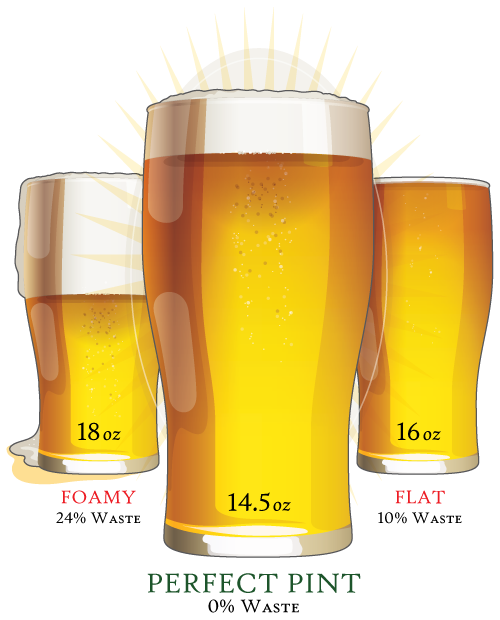
The perfect pint. Saves the pub money too. Win Win.
Easy isn't it? Unfortunately, I know that nearly everyone who reads this will be thinking that this is a
"perfect world" scenario, and will be thinking back to the last pint of beer they were served. The only way that beer service can be improved is by the customer knowing what should be done, and acting on it if it isn't. I find that if the bar tender or owner isn't interested, then a good way is to write a quick email to whichever local brewers beer they are selling. A Le Coq give out "beer stars" to places with good service, but they are equally quick to take it away (along with any discounts) if they aren't happy with the condition of the beer or service.
So next time you walk into a bar, and interrupt Svetlana from her Sudoku, explain to her that you'd like your beer poured in a single number of attempts without the use of a teaspoon, or she might be puzzling why she's lost her job.