Showing posts with label drink baar james. Show all posts

Wednesday, 8 August 2012

The perfect pint.

I did a blog a couple of months ago about how to spot a dirty glass from a clean one when in a pub. Lots of people thought it was useful, and it occurred to me, that there isn't really a manual you can refer to when you are in a bar to see if everything is being done in the correct way.  One indication of course are the amount of people in the place. An empty pub, with bored staff is usually a good guideline that something is wrong. A closed pub, or one with "remont" in the window is another.


                                                   Remont.


When I was living in the UK, I used to work for a large brewery. This brewery invested in a training programme for all the pubs which served it's beer, making sure that it's beer was perfect from "grain to glass". Because after all, it's normally the beer that gets the bad reputation if you have had a bad one in a bar. I used to teach the people who served the beer what beer is, how it's made, what it tastes of, and most importantly - how to present it correctly.

The worse people to train were those who had been working in a bar for years. They think that they know it all and that the stupid customer would be happy with any beer that made them drunk. It was these people that I used to pick on, and ask them to pour the "perfect pint" in front of the group. Nine times out of ten they'd do it completely wrong. You can't teach an old dog new tricks. The best people to teach are actually those who haven't worked in a bar before, or are just learning the art. They haven't had the chance to pick up any bad habits yet.


                                           Not a classic English pint.


Maybe it's best not to know any habits at all. When I'm on the other side of the bar in a pub and waiting for my pint, it's sometimes a very painful experience. Estonia has the dubious honour, of being the first country I visited where I saw a teaspoon being used to help serve me my beer. I guess we've all seen it:

Walk up to the bar, and Svetlana (and they're all called Svetlana) is perched on a chair reading a magazine or trying to work out how to play Sudoku. "Hello" I beam in my best Hugh Grant accent, "I'd like a Krusovice please". "Ei Ole", she replies in her best pissed off accent. Umm ok. "How about a Budvar then thanks?" Shake of head by Svetlana with one eye on the Sudoku.  (It's worth pointing out that I wasn't just choosing random beers - these beers were all on the beer taps in front of me). "So what have you got then?" Saku she replied while starting to pour it. I guess I'll be having Saku then.  She then went through an incredible exercise of holding the glass upright and pouring the beer into it very fast. What happened then, was as the glass half filled with foam, she crossed over to the sink, got a teaspoon from it, and started to scoop all the foam out into the sink. She then returned to the pump, shot another load of foam and beer into the glass and repeated the trip to the sink and spoon again. This happened about five times, before she was finally happy (or bored - I don't think Svetlana's are ever happy) that there was enough beer in the glass for her to be able to charge me 40 kroon. Her only smile came when I gave her a 50 kroon note and she told me that she didn't have any change.


Svetlana doesn't even need to speak to customers anymore


This may have been seven years ago, but I bet if I walk into that bar today, the very same teaspoon will be sitting by the edge of the sink. The really sad thing is, that it's not just this bar. There's a Svetlana working in pubs all over town.

So how should the bartender pour the perfect pint? It's easy isn't it - pick up the glass, pull back the tap, fill it with beer and hand it to the customer. Job done. Where's my tip?  Not so fast Tom Cruise....

Here's a 10 step guide of what should happen when you ask for a beer:

1) You should get a smile and a hello. There should be a short amount of time for you to choose your beer, and then if you still haven't, the person behind the bar should ask if you need a help in deciding what you want. Please try and be a helpful customer and don't just say "a beer". You wouldn't walk into a bar/restaurant and order "a wine" would you? If you know what you want, proceed to Step 3.

2) Once you've specified what type of beer you'd like (light, dark, strong, sweet, local, import etc), then hopefully the bar tender should be able to help you out and offer you some suggestions. A great idea from the bartender would be to allow you some samples from their draught selection to help you make the right choice.

3) Once you've decided, then the bartender should select the correct, clean, dry, glass (see the previous blog about glassware) and begin the pour.

4) Holding the bottom half of the glass (Mantra: Top half customer, bottom half bartender. You don't want fingers that have been handling money, beer kegs and bar flies all over the part that you put your lips on do you?), at an angle of 45 degrees, the glass is placed UNDER the spout but not touching it. The reason for this is that beer dries quite quickly and can form a crust on the outside of the spout when it's not being used. If the spout is put into the beer, then this crust can end up in your pint. And what about the story of the man who liked to drink out of the same glass for each beer without changing it? This man had nice cold sores on his lips. The bar tender liked to put the spout into the beer when pouring. The next day - everyone in the bar also had cold sores.

5) Treating the tap gently, the bar tender pulls back in one motion. It's not a slot machine and you don't get any more beer out for pulling it back quickly. Pulling it back slowly is just as bad too. Think about when you have a hosepipe and you put your thumb over it when there is water coming out. This is exactly what happens when the tap is opened too slowly. So in a fluid motion, the tap is opened and the beer comes out. The best method is to have the glass in the right hand facing towards the body. The beer should be hitting the top half of the glass and building up a small amount of head by the time the liquid reaches the top edge. This is when it should be straight up and almost full. Leaving a couple of cm short of the rim is the trick here.

6) The bartender should then "cream" the beer. This is a process of pushing back on the tap, which lets the beer come through a very narrow space in the spout. The effect is that there is more foam than liquid coming through the hole, leaving a nice head of a centimetre on top of the beer. Of course, if the beer is a Guinness, then there will be the mandatory 119.5 seconds settling time (inside knowledge - any good bar tender should be able to pour a Guinness in one go. It's all marketing).

7) If any beer has dripped down the sides, the bar tender should use some clean kitchen paper and wipe the sides of the glass. A teaspoon or dirty towel are not recommended!

8) Once again, holding the bottom half of the glass with the right hand, the bar tender should place a drip mat on the counter with the left hand, and put the glass down on top of it. If the glass is branded or has a handle, a nice touch is to rotate the glass around so that handle/logo are facing the customer.

9) The bartender should then ask if there is anything else, and if not, work out how much you owe them and tell the customer the amount in a pleasant undemanding (but authoritative) manner.

10) When all money transactions are done, then the bartender will say thank you and will tell you to enjoy your beer.
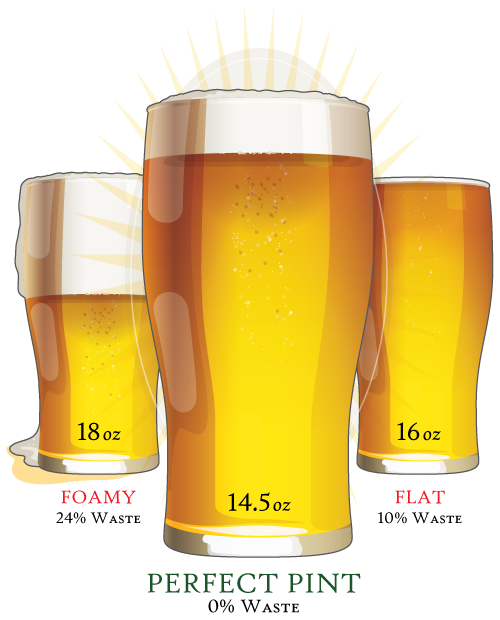
               The perfect pint. Saves the pub money too. Win Win.

Easy isn't it?  Unfortunately, I know that nearly everyone who reads this will be thinking that this is a "perfect world" scenario, and will be thinking back to the last pint of beer they were served. The only way that beer service can be improved is by the customer knowing what should be done, and acting on it if it isn't. I find that if the bar tender or owner isn't interested, then a good way is to write a quick email to whichever local brewers beer they are selling. A Le Coq give out "beer stars" to places with good service, but they are equally quick to take it away (along with any discounts) if they aren't happy with the condition of the beer or service.

So next time you walk into a bar, and interrupt Svetlana from her Sudoku, explain to her that you'd like your beer poured in a single number of attempts without the use of a teaspoon, or she might be puzzling why she's lost her job.


Sunday, 15 July 2012

Opening a new can of worms.

Today I got a new delivery of beers which I'm pretty excited about. They have come all the way from Maui, Hawaii. I've got an American IPA called "Big Swell" and a porter with toasted coconut called "CoConut Porter" (the weather is probably too hot to be creative). I got them via Mikkeller in Denmark, and felt I had to bring them to Estonia - 1) because they are pretty great beers, and 2) because there really couldn't be two opposing climates to drink beer in. It's currently raining in Tallinn, but lets hope these tropical beers let a bit of sunshine into our Baltic summer.


I almost didn't order them. In truth, I'm still a bit nervous that I did. Ok, I've only got 15 cases of each, but what makes me nervous is that I might not even be able to sell this small amount. "Why?" I hear you ask. "But you said they were great beers?" I hear you cry.  "Because they are in cans" I mutter in a casual back handed, slightly sheepish sort of way.


Beer in cans - that's cheap beer to you and me isn't it? We've all been conditioned into thinking that cans are commodity and glass is premium. I mean - you don't look as cool drinking a Corona out of the can at the local "venue" bar do you? And I've got to admit, when I saw that the Maui beers were available, and then looked at the packaging column on the excel spreadsheet and saw "355ml Can", my heart sank. I really wanted this beer. Estonia really wanted this beer. But does Estonia know anything about quality beers in cans? I thought back to the last beers I had in cans, and fortunately, they were from the Oliver Twist bar in Stockholm - the leading supplier/stockist of craft American beer. Dales Pale ale, Ska Brewing Modus Hoperandi, New Belgium to name but a few. When I was in the UK, I was very partial to Bass pale ale in cans - which was specially brewed with more hops for the canned version.  So I took the plunge and ordered some. After all, I had the same feelings when I placed my first order for Brewdog....


Revolution is a word Brewdog are fond of. They are revolutionising the beer market as we know it with "out there" beers, and styles that differ from the norm. On the cans by Maui Brewing, they use the word revolution too. Here's what's written for you to read.....


WHY CANS? WELCOME TO THE MICROCANNING REVOLUTION...
Cans eliminate light damage and help reduce the risk of oxidation, keeping this craft brew fresher than in bottles!
Cans are lighter, chill quicker, and can be enjoyed on beaches and in sensitive environments. Aluminium is the most re-cycled and eco-friendly material.


The "Metallic" Myth.

Bottles are fine, I guess, if only because so many beers I love come only in bottles. But the thing that matters most—taste—doesn't change a bit in a can.
The next time someone says canned beer tastes "metallic", cut a can in half and ask him to show you where the metal ever actually touches the beer. Then he'll point at the inside of the gleaming can and say, "Right there geek. I'm guessing all the metal."
What your friend is missing is the epoxy lining that is sprayed on the inside of every can, the same stuff that has been used for about 40 years.


Keg beer.
Think about the new wave of craft draught beer. That comes in a keg, right? A big, metal keg that is lined with the same type of coating as your humble little can. In fact, back in the '30s American brewers started selling beers in cans they advertised it as "keg-lined."  It took a little longer in the UK, as the market was still dominated by cask, but in the late 70's early80's, Watneys brought out a 7 pint keg, and it was swiftly followed by a glut of canned beer.

Is it possible that canned beer tastes better than bottled beer? Well, sure, depending on circumstances.  But that's often because of the way beer is transported from the brewery to the store. Light will accelerate the oxidation of beer—that's why most brewers use brown bottles, not green—but it's not the only way a beer develops off flavors like that of the aldehyde trans-2-nonenal, which can make light-colored beers off - a little skunky, and in some cases a bit like lipstick (don't tell your wife/girlfriend/partner that she tastes like stale beer next time you are in the throws of passion. I don't think she'll see the geeky side).
Heat's actually just as big a factor. If your beer stays refrigerated from the brewery to the bar or shop, without sitting on a shelf somewhere at room temperature, everything should be great. But of course that is in the make believe world. It rarely happens in real life. This is all worth bearing in mind that a canned beer won't be subject to light oxidation like a bottle beer would.
Of course it doesn't really matter if it's a generic lager, or lesser hopped ale. But those who have read my previous blogs, know that hops don't like sunlight once they are in the beer. This is why IPA's - especially heavily dry hopped beers, are in dark bottles. The sun makes the essential oils in the hops break up and give off bad aromas. Fine for a beer like Corona or Sol with very little hops (think about the colour of these bottles), but very bad for an IPA, especially an American IPA which is packed full of the plant.
Green - but not green glass.
Canned beer's benefits don't stop at freshness. Cans are easier on the environment. They are nearly 50 percent lighter to ship than bottles, which greatly reduces their carbon footprint.  Aluminum is infinitely recyclable, and recycled cans can be back on the shelf with new product within eight weeks. 

It's easier to store and transport.
Got some friends coming over for a bbq? They'll be drinking beer of course. Lots of it. Better stock the fridge to the max. How many times have you played Jenga with your beer bottles? Trying to stack them in the fridge without them rolling around, is a skill in itself. With cans, you don't have that problem. 6 pack or 4 pack, you just slide them in. Being in aluminium chills them down faster than glass too. And although I don't advocate ice cold beer, the quicker it is to cool an IPA down to 12 degrees the better.
Going into the forest with some mates? Don't fancy glass rolling around the boot of your car or backpack? Cans are safer. Going down the beach with the guys and girls - don't want to run the risk of dropping some glass bottles on the rocks? Take some cans. At least, if you drop them - you can probably salvage a few drops, or at the very lowest, enjoy spraying beer over everyone.

So I've got to admit, I have a changed viewpoint. As I said right at the beginning, I thought of the great beers I tried in can, and used these to sway my decision to bring them to Estonia. But up until then - those beers have always been "novelty beers". Beers that are "great beers but in a can".  I spoke to one of the guys at Oliver Twist and they told me that they tried New Belgium Fat Tire amber, side by side in both bottle and can. The can won hands down. It tasted fresher, more creamier and had a much more roasted pallet than it's bottle counterpart. Punk IPA is available in cans. Who knows - if I get good feedback about these beers, then I can really join the "microcanning" revolution and bring Brewdog in metal over to Estonia.


So put the thought about canned craft beer being blasphemous to one side and try these two new beers that are available to you. You'll also have to leave the "canned beer is cheaper" mindset behind too, as these beers are the same price as craft beer in bottles. Buy them with an open mind - thinking about how much fresher they may be. How quicker you'll be able to drink them at the right temperature, and how they won't smash into a million pieces when you drop the bag onto the road on the way home. Maybe even find the geek in you, and serve them to someone in a glass without telling them that the beer came from a can. (Important note - just because these beers are in a can, doesn't mean that you can drink it from the can. These beers are full of wonderful aromas and freshness - you absolutely must pour them into a glass).
Whatever you do, this is about breaking new ground in beer drinking, and it's nice to be a part of it isn't it? Now that's something I CAN relate to. (I'll get my coat. And my backpack complete with 6 pack).